

Calgary's rental market is working through one of the most active apartment-building booms in North America. More than 11,000 units are still under construction, asking rents have slipped 1.0 per cent in a year, and renters are finding more choice and more incentives than they have in years.
Calgary at a Glance
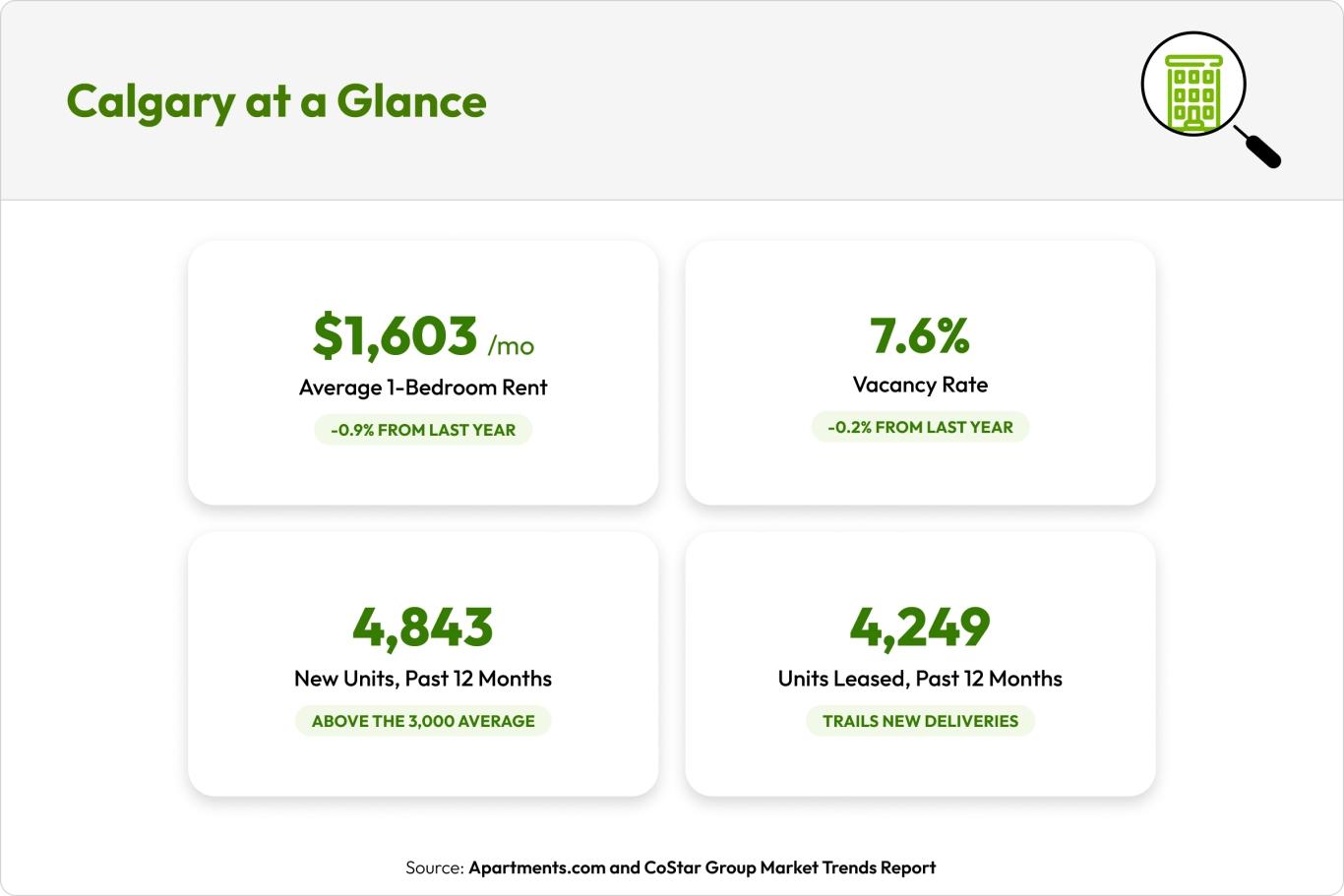
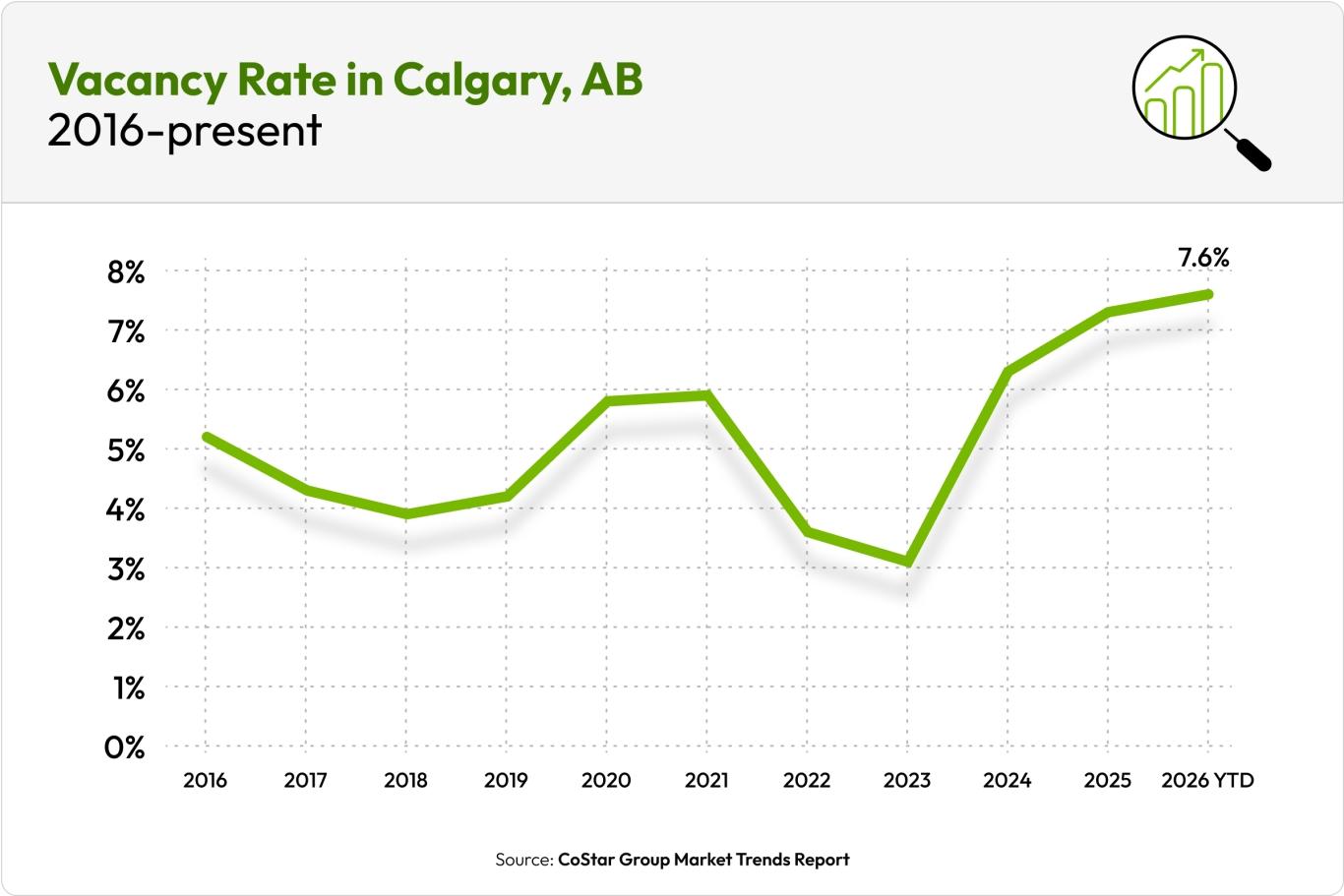
Calgary’s purpose-built rental market is recovering after a surge of new construction, with vacancy at 7.6 per cent, up from 3.0 per cent in early 2024. Unlike markets where the slack is concentrated at the top end, availability is elevated across the board: luxury communities carry a vacancy of 8.6 percent, compared with 7.6 per cent for mid-range communities and 5.5 per cent for low-end buildings.
What this means for renters: Renters are gaining negotiating room, and recently completed communities commonly offer one to three months free on 12-month leases. With about 4,700 luxury units and 6,700 mid-range units still under construction, that choice is unlikely to shrink soon.
|
Average 1-Bedroom Rent |
Average Rent Change |
Vacancy Rate |
New Units, Past 12 Months |
Units Leased, Past 12 Months |
$1,603per month |
-0.9%year-over-year |
7.6%Down 0.2 points from last year |
4,843Above the 3,000 average |
4,249Trails new deliveries |
Rent: Asking Rents Drop as Landlords Lean on Concessions
The average asking rent in Calgary now stands at $1,603 per month for a one-bedroom apartment, down 0.9 per cent from a year ago and 8.9 per cent higher than the Alberta average. The concession rate is 4.2 per cent, bringing the average effective rent down to $1,536 per month for a one-bedroom.
"It's all due to a record level of new supply, a familiar story amongst most major markets in Canada."
Paul Richter, Director of Market Analytics for Alberta, CoStar Group
Rent growth peaked at 8.8 per cent in early 2023 before reversing as new supply arrived; the weakest reading, negative 2.7 per cent, came in the second half of 2025.
“It’s all due to a record level of new supply, a familiar story amongst most major markets in Canada,” says Paul Richter, CoStar Group’s director of market analytics for Alberta. “Alberta markets (Edmonton and Calgary) continue to lead the country in population growth; however, the supply wave has limited rent growth across all rental buildings.”
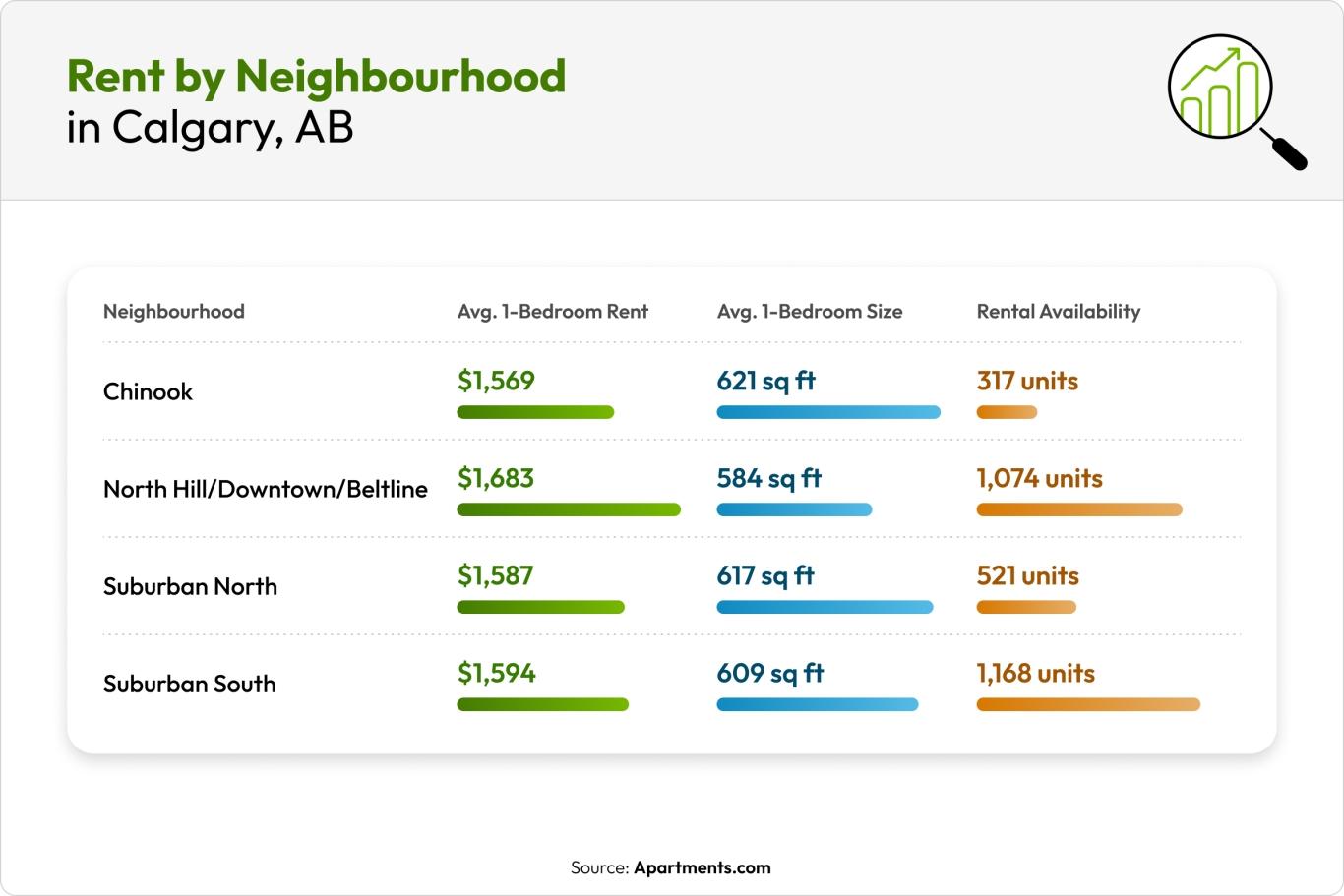
Where the deals are: North Hill/Downtown/Beltline has the biggest discounts of the region, at an average 5.2 per cent off asking rent, but also the highest rents at $1,683 for a one-bedroom. Chinook has the lowest rents at $1,569 for a one-bedroom, and the 3.3 per cent concession rate brings the average effective rent down to $1,517 per month.
North Hill/Downtown/Beltline has the highest rents, at $1,683 for a one-bedroom.
|
Neighbourhood |
Average 1-Bedroom Rent |
Average 1-Bedroom Size |
Rental Availability |
|
$1,569/month |
621 sq ft |
317 units |
|
|
$1,683/month |
584 sq ft |
1,074 units |
|
|
$1,587/month |
617 sq ft |
521 units |
|
|
$1,594/month |
609 sq ft |
1,168 units |
Vacancy: New Buildings Take Longer to Fill
Calgary’s overall vacancy rate has risen to 7.6 per cent, up from 3.0 per cent in early 2024 and above the historical average of 5.0 per cent. Even settled communities are feeling it: the stabilized vacancy rate, which leaves out new properties still filling up, has climbed to roughly 5.0 per cent from about 2.0 per cent in 2023. Larger new communities now commonly need 12 to 18 months to reach full occupancy.
By class, vacancy stands at 8.6 per cent for luxury communities, 7.6 per cent in mid-range buildings and 5.5 per cent in low-end buildings, a sign that affordability is giving older communities a competitive edge.
Renters are trading up, and demand is moderating
Over the past 12 months, renters leased 4,249 units. That’s well above the long-run average of about 2,600, but short of the 4,843 units delivered over the same period. With more choice on offer, renters can move into newer communities without stretching their budgets, which leaves vacancy in both new and older stock.
Population has cooled from its recent highs, and tighter federal immigration policy is expected to slow in-migration further. Even so, renters continue to be drawn by housing costs below those in Vancouver and Toronto and employment growth of 5.0 per cent over the past year against 0.6 per cent nationally.
Construction: Supply Pressure Stays On
Roughly 11,500 units are under construction in Calgary, equivalent to 13.2 per cent of existing inventory. Over the past 12 months, 4,843 units were delivered, well above the historical average of about 3,000 units.
Richter says the Canada Mortgage and Housing Corporation (CMHC) has played a major role in the recent supply wave.
“CMHC, a quasi-federal governmental organization, has provided some exceptionally favourable lending terms to entice builders to construct rental housing,” says Richter. “This started a number of years ago, but the program began to get extensive buy-in when the condo market started to soften, some may say crater. Builders pivoted to purpose-built rentals, and a wave of supply began to hit the market.”
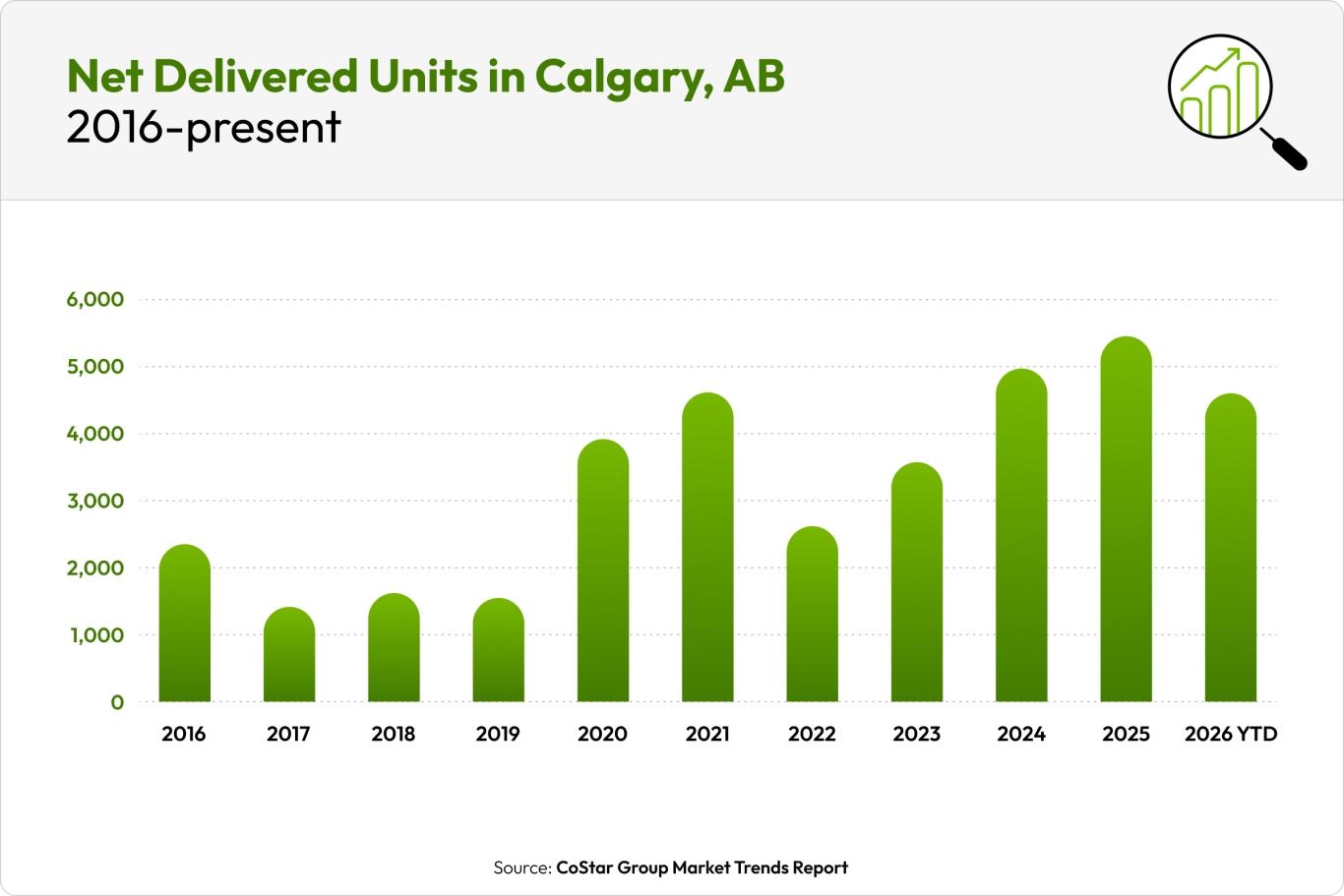
The construction pipeline spans the mid-market and top end: about 6,800 of the units under construction are mid-range and about 4,700 are luxury communities. Today’s elevated vacancy partly reflects projects started when population and rent growth were exceptionally strong, and development activity is already slowing as those economics change.
Methodology
The rent data in this report is sourced from CoStar Group’s Market Trend reports. CoStar Group is the leading authority in commercial real estate information, analytics, and news, trusted by real estate professionals for nearly 40 years. By combining this data with Apartments.com internal data and public record, we’re able to deliver the most up-to-date rental information available.
FAQs
What is the average rent in Calgary right now?
The average rent in Calgary is $1,603 per month, as of November 2026.
Are rent prices rising or falling in Calgary?
Rent prices in Calgary are falling, averaging 0.9 per cent lower than last year.
Where is rent cheapest in Calgary?
Chinook has the lowest rents at $1,569 for a one-bedroom.


