

While Indianapolis is often named as one of the cities where homeownership is still attainable, if you’re purely looking at the most affordable housing option, then renting may be a better fit. It’s tempting to just look at Indianapolis’ median mortgage and assume it’s just a couple hundred dollars more a month to be a homeowner.
However, you need to consider not only the monthly payments, but also upfront costs, additional expenses, and the cost of living to truly see the price difference between renting and owning. We’ve broken down the housing costs in Indianapolis to show how and why renting in Indianapolis is still cheaper than a mortgage.
Key Takeaways
- Homeownership in Indianapolis costs $474 more per month than renting, even before insurance, taxes, and utilities.
- Renters in Indianapolis pay $3,349 less per month in overall cost of living than homeowners.
- Buying a home in Indianapolis requires $54,128 upfront, compared to just $2,621-2,812 to rent.
It Costs $474 a Month More to Own a Home in Indianapolis
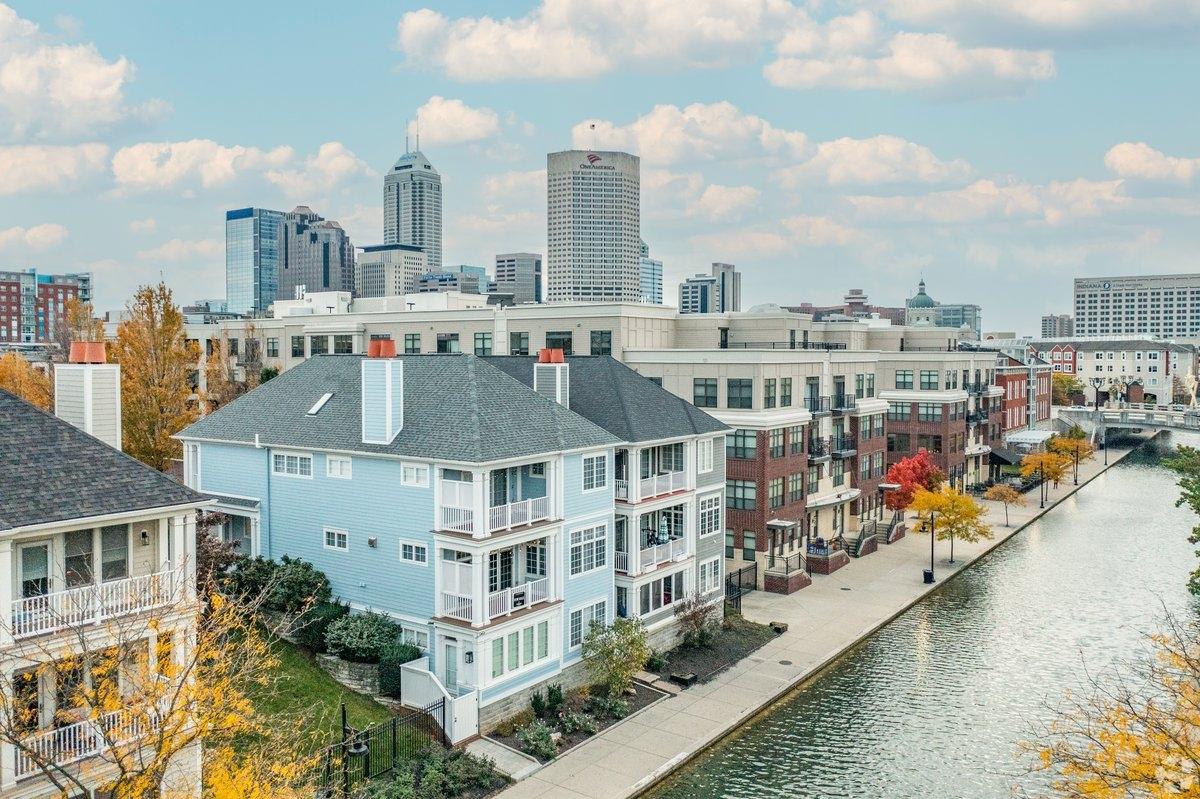
While the Sun Belt has been a renter hotspot for affordability for several years now, the Midwest has pushed itself to the forefront of the conversation as well. This includes Indianapolis, which has a lower average rent of $1,125/month. That price can drop even lower in the most affordable neighborhoods in the city.
Homeowners have to pay $474 more a month than renters; the Motley Fool Money reports that the median mortgage in Indianapolis is $1,598. The true savings are possibly even more substantial as this number doesn’t account for the cost of living, insurance, taxes, down payment, or other expenses.
Rents are below state averages, while mortgages aren’t
The cost of renting in Indianapolis is below the state average, while mortgages aren’t, making the price difference stand out. The average rent for Indiana is $1,141/month, and Indianapolis sits $16 below that. However, the median mortgage in the city is $194 more expensive than the state median of $1,404.
Indianapolis has a rent 33 percent lower than the national average of $1,666/month, compared to homeownership’s 0.1 percent
When looking at state average, renting comes out on top, but it also comes out on top when comparing numbers to national averages. The average rent in the city is 33 percent lower than the national rent of $1,667. On the other hand, the median monthly mortgage payment in Indianapolis, at $1,598, is nearly identical to the national median of $1,600, just 0.1 percent lower. That gap shows renting delivers bigger savings in Indianapolis, while owning offers little to no cost advantage over the national median.
Insurance Costs and Property Taxes: Homeowners Spend $716 More a Month Than Renters
A monthly mortgage doesn’t just include the mortgage payment. Homeowners also need to pay insurance and property taxes. This can make the total monthly payment higher than anticipated.
|
Cost Category |
Renters |
Homeowners |
|
Base Housing Cost |
$1,125/month |
$1,598/month |
|
Property Taxes |
Typically factored into rent, not paid separately |
$169/month $2,028/year (Marion County median – Tax Foundation) |
|
Insurance |
$17/month $205/year |
$156/month $1,876/year (SoFi) |
|
Additional Fees |
~$65 |
— |
|
Total Added Costs |
$82/month |
$325/month |
|
Total Monthly Cost |
$1,207/month |
$1,923/month |
A 7.28 Percent Mortgage Rate Is Making Ownership Expensive Nationally
While both rent growth and mortgage rates have increased over the past couple of years, mortgage rates have been making national news with their sudden jumps. As of the week of October 8, 2026, the 30-year fixed-rate mortgage rate averages 7.4 percent, up from 7.28 percent the previous week. This is the highest it has been since fall 2023.
The Cost of Living for Renters in Indianapolis Is $3,349 Lower Than for Homeowners

Indianapolis already has a favorable cost of living, which is 10.3 percent lower than the national average. That advantage widens further when comparing renters and homeowners.
Renters should expect to pay around $4,346/month to cover household expenses, according to Apartments.com cost of living data. Homeownership comes with a higher cost of living, as owners should expect to pay about $7,695/month. That’s roughly 75 percent more than what renters pay monthly.
Utilities are a major expense category, and renters again come out ahead. While utilities in Indianapolis are overall below national averages, renters pay about $347 a month while homeowners spend about $799 a month. Homeowners pay more than double what renters pay, showcasing another area where renters save a couple hundred dollars.
Upfront Costs for an Apartment are Only $2,621-2,812 Compared to a House’s $54,128

Both renting and owning a home have upfront costs, but homeownership has a much higher entry point as it requires a much larger amount.
Buying a home in Indianapolis requires $54,128 upfront
The National Association of Realtors (NAR) says the typical down payment is $51,510 for the Indianapolis metro area. LodeStar reports that for the state of Indiana, the average total closing costs with recording and taxes is $5,184, or about 0.69 percent of the sales price. For Indianapolis’ average listing price of $379,540, that would be a closing cost of $2,618. In total, that is $54,128 that you would need to have on hand to purchase a home.
This is a huge chunk of change that can take years to save up. The NAR says that would take Indianapolis residents four years to save up for a down payment, assuming the household makes the median household income and that they save 15 percent of their income each year.
Upfront costs for renters in Indianapolis range from $2,621-2,813
Upfront costs for renters are harder to track as the fees vary from community to community and city to city. Renting generally has a much lower cost entry barrier compared to homeownership and usually consists of a security deposit, move-in fees, and first or last month’s rent. The actual amounts can vary quite a bit, so we estimated calculations based on Indianapolis’ average rent of $1,125.
Move-in fees include a range of expenses, such as application and administration fees that are typically non-refundable. A good rule of thumb is to multiply the rent by 33-50 percent. That would be somewhere from $371 to $562 for Indianapolis, based on an average rent of $1,125.
First or last month’s rent is another common charge. While it’s technically just a rent payment, as it's due when you move in, it is still an upfront cost you need to budget for. Security deposits are another move-in expense that generally equal one- to two-month’s rent and are refundable. That comes to about $1,125 for each charge, or $2,250 total.
Combining move-in fees, first or last month’s rent, and a security deposit, Indianapolis renters’ final upfront costs range from $2,621 to $2,813. That’s a meaningful expense, but it’s still a fraction, about one-twentieth, of the $54,128 that homeowners need from the start.
Total Cost: Renters vs. Homeowners in Indianapolis Per Month
On both the upfront and the monthly cost fronts, renting has a leg up compared to homeownership. It will cost you $1,168 more a month to be a homeowner, including total monthly costs and utilities. Probably the biggest gap of all is in the upfront costs, where a down payment and closing costs can equal tens of thousands that take years to save up. Even though Indianapolis may have home costs lower than other cities, renting is still much cheaper than a mortgage.
|
|
Renters |
|
Homeowners |
|
Average Rent |
$1,125 |
Median Mortgage |
$1,598 |
|
Renters Insurance |
$17 |
Homeowners Insurance |
$156 |
|
Monthly Fees |
$65 |
Median Property Taxes |
$169 |
|
Total Monthly Costs (Rent+Renters Insurance+Monthly Fees) |
$1,207 |
Total Monthly Costs (Mortgage+Homeowners Insurance+Property Taxes) |
$1,923 |
|
Utilities |
$347 |
Utilities |
$799 |
|
Total Monthly Costs + Utilities |
$1,554 |
Total Monthly Costs + Utilities |
$2,722 |
|
|
|
|
|
|
Security Deposit |
$1,125 |
Down Payment |
$51,510 |
|
First or Last Month’s Rent |
$1,125 |
Closing Costs |
$2,618.83 |
|
Move-in Fees |
$371-562 |
|
|
|
Total Upfront Costs |
$2,621-2,812 |
Total Upfront Costs |
$54,128 |
Ready to See What Renting Can Save You in Indianapolis?
The numbers make it clear: renting in Indianapolis comes out ahead on both monthly costs and upfront cash, and the gap only grows once you factor in insurance, taxes, and cost of living. If you're ready to put those savings to work, Apartments.com makes it easy to find your next place. Search thousands of available listings across Indianapolis by price, amenities, neighborhood, and more. Start your search on Apartments.com and find an apartment that fits your budget today.
FAQs
What is a good salary to live in Indianapolis?
According to Apartments.com cost of living data, a salary of about $68,000 is recommended to live comfortably in Indianapolis. That breaks down to roughly $22,272/year for housing, $8,340/year for groceries, and $11,484 for goods, services, and other expenses. Of course, this varies by household size and neighborhood.
What are the best places to live in Indianapolis?
There are many great neighborhoods in Indianapolis, from along the canal to in the heart of the high-rises. Some of the best include Broad Ripple, Meridian-Kessler, Irvington, and the Canal. Each offers a mix of walkability, green spaces, entertainment, and access to downtown.
Are home prices going down in Indiana?
Homes.com says home prices are actually rising in Indianapolis as the median price has increased 2.2 percent over the past year. That amounts to about a $7,055 increase to the current median price of $325,000.


